

Verified NEX Dumps Q&As - NEX Test Engine with Correct Answers
Pass Your NEX Dumps as PDF Updated on 2026 With 152 Questions
NEW QUESTION # 85
A nurse needs to administer 0.75 liters of IV fluid over 3 hours. What is the flow rate in milliliters per hour?
(1 liter = 1,000 milliliters)
- A. 250 mL/hr
- B. 300 mL/hr
- C. 150 mL/hr
- D. 200 mL/hr
Answer: A
Explanation:
This question tests unit conversion and rate calculation, both of which are essential skills on the NEX Math Section, especially for medication and IV flow problems. First, convert liters to milliliters because flow rates are typically expressed in milliliters per hour. Since 1 liter equals 1,000 milliliters, multiply 0.75 liters by
1,000 to get 750 milliliters. Next, determine the flow rate by dividing the total volume by the total time. The fluid is administered over 3 hours, so divide 750 milliliters by 3 hours. This calculation gives 250 milliliters per hour. Therefore, the correct answer is option C. Option A results from dividing incorrectly, option B reflects underestimation, and option D would be correct only if the volume were larger. NEX exam questions often focus on proper setup of unit conversions before performing calculations. Always convert units first, then divide by time to find a rate.
======
NEW QUESTION # 86
Reading Comprehension
Passage:
Hand hygiene is one of the most effective ways to prevent the spread of infection. Washing hands with soap and water removes many harmful microorganisms. When soap and water are not available, alcohol-based hand sanitizers can reduce the number of germs, though they are not effective against all pathogens.
Which statement is best supported by the passage?
- A. Handwashing helps reduce the spread of infection
- B. Hand sanitizers eliminate all microorganisms
- C. Soap and water are unnecessary if sanitizer is available
- D. Microorganisms cannot survive on hands
Answer: A
Explanation:
The passage emphasizes the importance of hand hygiene in preventing infection. It clearly states that washing hands with soap and water removes harmful microorganisms and that sanitizers can reduce germs when soap is unavailable. This supports the conclusion that handwashing helps reduce the spread of infection. Option C directly reflects this main idea. Option A is incorrect because the passage notes that sanitizers are not effective against all pathogens. Option B contradicts the passage, which presents soap and water as the most effective method. Option D is false because the passage acknowledges that germs can exist on hands. On the NEX exam, supported-detail questions require selecting an answer that accurately restates information from the passage without exaggeration or contradiction.
======
NEW QUESTION # 87
What is the correct order of blood flow through the cardiovascular system?
- A. Heart # arteries # veins # capillaries # heart
- B. Heart # arteries # capillaries # veins # heart
- C. Heart # veins # lymphatics # arteries # heart
- D. Heart # venules # capillaries # arterioles # heart
Answer: B
Explanation:
Blood flows in a continuous loop through the cardiovascular system. It is pumped from the heart into arteries, which carry oxygenated blood away from the heart. Arteries branch into smaller vessels that lead to capillaries, where gas and nutrient exchange occurs. Blood then flows into veins, which return deoxygenated blood back to the heart. The other options list structures in an incorrect order. Understanding blood flow pathways is a fundamental concept on the NEX Science exam and is essential for interpreting cardiovascular function and disorders.
======
NEW QUESTION # 88
Reading Comprehension
Passage:
Sleep deprivation can impair immune function, making individuals more susceptible to illness. Over time, chronic lack of sleep may increase the risk of serious health conditions.
Which statement is best supported by the passage?
- A. Illness always results from lack of sleep
- B. Immune function improves with stress
- C. Adequate sleep supports immune health
- D. Sleep has no effect on immunity
Answer: C
Explanation:
The passage states that lack of sleep weakens immune function and increases susceptibility to illness. This supports the conclusion that adequate sleep supports immune health. Option C accurately reflects this relationship. Options A and D contradict the passage, while option B exaggerates the effect. NEX questions often test the ability to infer logical conclusions without overgeneralizing.
======
NEW QUESTION # 89
Reading Comprehension
Passage:
Sleep plays a critical role in memory consolidation. During certain stages of sleep, the brain processes and stores information learned throughout the day. Lack of sleep has been linked to impaired judgment, slower reaction times, and decreased academic performance.
Which conclusion is best supported by the passage?
- A. Memory formation is affected by sleep
- B. Sleep is only important for physical health
- C. Academic success depends solely on sleep duration
- D. People can function normally without sleep
Answer: A
Explanation:
The correct answer must be directly supported by the information in the passage. The passage clearly explains that sleep helps the brain process and store information, which is essential for memory consolidation. It also states that lack of sleep negatively affects cognitive abilities such as judgment and reaction time. Therefore, the conclusion that memory formation is affected by sleep is well supported. Option A is incorrect because the passage emphasizes mental and cognitive effects, not just physical health. Option C is directly contradicted by the passage's mention of impaired functioning due to lack of sleep. Option D exaggerates the information; while sleep affects academic performance, the passage does not claim it is the sole factor. On the NEX exam, supported-conclusion questions require selecting an answer that is neither too extreme nor unsupported by the passage.
======
NEW QUESTION # 90
Three nurses work a combined total of 130 hours each week. If Nurse A worked 5 days forhours each day, and Nurse B worked 4 days forhours each day, how many hours did Nurse C work?
- A. hours
- B. hours
- C. hours
- D. hours
Answer: D
Explanation:
This is a multi-step word problem involving mixed numbers and total subtraction, commonly seen on the NEX. First calculate Nurse A's total hours:. Multiply by 5 days:hours. Next, calculate Nurse B's total hours:.
Multiply by 4 days:hours. Now add the hours worked by Nurses A and B:
41.25 + 42 = 83.25 hours (or).
Subtract this from the total combined hours:
130 # 83.25 = 46.75 hours.
Convert 0.75 to a fraction:.
So Nurse C workedhours, making option D correct. The NEX often tests accurate step-by-step calculation with workplace scenarios.
======
NEW QUESTION # 91
Review the image below.
Which is the best piece of evidence that the blue whale evolved from a mammal that once lived on land?
- A. C - rib cage
- B. B - vestigial leg bones
- C. D - jawbones
- D. A - spinal column
Answer: B
Explanation:
Vestigial structures are anatomical features that are reduced in size and function compared to their ancestral form. In whales, vestigial leg bones are remnants of hind limbs that were fully functional in land-dwelling ancestors. These bones no longer serve a locomotor purpose but provide strong evolutionary evidence of descent from terrestrial mammals. The spinal column, rib cage, and jawbones are found in many vertebrates and do not specifically indicate a land-based ancestry. Vestigial leg bones, however, directly point to a time when whales had legs and lived on land before adapting to an aquatic environment. The NEX Science exam frequently tests evolutionary evidence, especially the significance of vestigial structures as proof of common ancestry and evolutionary change over time.
======
NEW QUESTION # 92
Review the image below.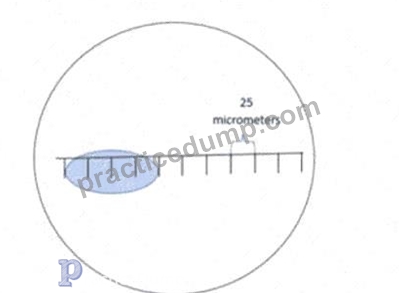
If each division in the ocular micrometer below equals 25 micrometers, what is the length of the oval?
- A. 100 micrometers
- B. 400 micrometers
- C. 500 micrometers
- D. 200 micrometers
Answer: D
Explanation:
This question tests measurement interpretation using an ocular micrometer, a skill often assessed on the NEX Science exam. An ocular micrometer is a scale placed in the eyepiece of a microscope and must be interpreted based on the given scale value. In this problem, each division equals 25 micrometers. By carefully counting the number of divisions spanned by the oval in the image, the oval covers8 divisions. To find the total length, the number of divisions is multiplied by the micrometer value per division: 8 × 25 micrometers = 200 micrometers. The other answer choices represent common calculation errors, such as counting too few or too many divisions or using an incorrect multiplication factor. The key to these questions is slow, accurate counting and correct unit conversion. The NEX exam frequently includes microscopy-based questions to assess practical lab interpretation skills.
======
NEW QUESTION # 93
Word Knowledge
The word"contribute"most nearly means:
- A. Prevent
- B. Add to
- C. Remove
- D. Ignore
Answer: B
Explanation:
To contribute means to add to or help bring about a result. Option B is the correct synonym. The other options describe the opposite action. NEX vocabulary often includes cause-and-effect language.
======
NEW QUESTION # 94
Word Knowledge
The word"beneficial"most nearly means:
- A. Harmful
- B. Helpful
- C. Costly
- D. Accidental
Answer: B
Explanation:
"Beneficial" describes something that produces a positive effect or advantage. "Helpful" is the closest synonym. The other options do not match the meaning. NEX vocabulary questions often test commonly used healthcare-related words.
======
NEW QUESTION # 95
Word Knowledge
The word"restrict"most nearly means:
- A. Limit
- B. Expand
- C. Encourage
- D. Allow
Answer: A
Explanation:
Restrict means to limit or control. Option C is the correct synonym. This word commonly appears in medical and safety contexts.
======
NEW QUESTION # 96
Reading Comprehension
Passage:
Public health campaigns often focus on smoking cessation because smoking is a leading cause of preventable disease. Reducing smoking rates can significantly lower the incidence of heart disease, lung cancer, and stroke.
Which outcome is directly associated with reducing smoking rates?
- A. Lower incidence of chronic disease
- B. Improved air quality indoors only
- C. Increased healthcare costs
- D. Higher infection rates
Answer: A
Explanation:
The passage clearly states that reducing smoking rates lowers the incidence of heart disease, lung cancer, and stroke. These are chronic diseases, making option C the correct answer. The other options are either not mentioned or incorrect. On the NEX exam, cause-and-effect reading questions require identifying outcomes that are directly linked to actions described in the passage. Choosing the most clearly stated effect is essential.
======
NEW QUESTION # 97
Word Knowledge
The word"temporary"most nearly means:
- A. Permanent
- B. Brief
- C. Frequent
- D. Severe
Answer: B
Explanation:
Temporary refers to something lasting for a short period of time. Option B correctly reflects this meaning.
Recognizing time-related descriptors is common on the NEX exam.
======
NEW QUESTION # 98
Four students were comparing their test scores on an exam. All questions were worth the same number of points.
* Student A: 19 out of 26
* Student B: 75 out of 100
* Student C: 71%
* Student D: 0.719
Which student scored the highest on the exam?
- A. Student A
- B. Student D
- C. Student C
- D. Student B
Answer: A
Explanation:
This problem requires comparing fractions, percentages, and decimals by converting them to the same form.
Convert each score to a decimal. Student A: 19 ÷ 26 # 0.731. Student B: 75 ÷ 100 = 0.75. Student C: 71% =
0.71. Student D: already given as 0.719. Comparing these values, 0.75 is the highest. Therefore, Student B scored the highest. Option D (0.719) is close but still lower than 0.75. The NEX frequently tests comparison skills across different numerical formats, so converting everything to decimals is the safest approach.
======
NEW QUESTION # 99
Where does saltatory conduction occur?
- A. Muscle cells
- B. Unmyelinated axons
- C. Dendrites
- D. Myelinated axons
Answer: D
Explanation:
Saltatory conduction is the rapid transmission of nerve impulses alongmyelinated axons. In myelinated neurons, the axon is covered with a fatty insulating layer called myelin, which is interrupted at gaps known as nodes of Ranvier. During saltatory conduction, the electrical impulse "jumps" from one node to the next, greatly increasing the speed of signal transmission. Unmyelinated axons conduct impulses more slowly because the signal must travel continuously along the entire membrane. Dendrites receive signals rather than transmit them over long distances, and muscle cells do not conduct nerve impulses in this manner. The NEX Science exam commonly tests nervous system physiology, particularly mechanisms that improve conduction speed, making myelinated axons the correct answer.
======
NEW QUESTION # 100
Word Knowledge
The word"evaluate"most nearly means:
- A. Predict
- B. Measure or assess
- C. Delay
- D. Ignore
Answer: B
Explanation:
Evaluate means to assess, judge, or determine the value or effectiveness of something. Option B is the correct synonym. Evaluation is a common term in healthcare and academic settings, making it a high-yield NEX word.
NEW QUESTION # 101
What is the term for organisms that are preserved for thousands of years by being buried in sediment, encased in amber, or frozen in ice?
- A. Fossils
- B. Ancestors
- C. Relics
- D. Remnants
Answer: A
Explanation:
Fossils are the preserved remains or traces of organisms that lived in the past. Fossilization can occur in several ways, including burial in sediment, preservation in amber, or freezing in ice. These conditions prevent decay and allow organisms or parts of organisms to remain intact for thousands or even millions of years.
Fossils provide critical evidence for understanding evolution, extinct species, and changes in life on Earth over time. The terms remnants, ancestors, and relics are not scientifically precise terms used to describe preserved organisms in geology or biology. The NEX Science section often focuses on basic concepts of evolution and Earth history, making fossil identification an important topic.
======
NEW QUESTION # 102
Which statement best explains why a child may resemble one parent more than the other?
- A. Older genetic material is weaker.
- B. Larger eggs contain more genetic material.
- C. One set of genes had more dominant characteristics.
- D. The genes of the dominant parent are expressed more vigorously.
Answer: C
Explanation:
Dominant traits are more likely to be expressed when present. If one parent contributes more dominant alleles, the child may resemble that parent more closely. Dominance does not mean stronger genes, just that they mask recessive traits. The NEX Science exam emphasizes basic Mendelian inheritance and dominance relationships.
======
NEW QUESTION # 103
Which of the following describes hyperextension of a body part at a joint?
- A. The anterior movement away from the anatomical position in the sagittal plane.
- B. The posterior movement away from the anatomical position in the sagittal plane.
- C. The posterior movement back to the anatomical position in the sagittal plane.
- D. The lateral movement away from the middle of the body (midline) in the frontal plane.
Answer: B
Explanation:
Hyperextension refers to movement at a joint that goes beyond the normal anatomical position in the sagittal plane, specifically in a posterior direction. For example, bending the head backward farther than upright posture is considered hyperextension. Option B correctly describes this movement. Option A describes abduction, which occurs in the frontal plane. Option C describes flexion, which is anterior movement. Option D describes extension back to anatomical position, not beyond it. The NEX Science exam frequently tests anatomical terminology related to joint movement, and understanding directional planes (sagittal, frontal, transverse) is essential. Hyperextension differs from extension because it exceeds the normal range of motion, which can increase injury risk.
======
NEW QUESTION # 104
......
Pass NLN NEX Exam Info and Free Practice Test: https://torrentpdf.practicedump.com/NEX-exam-questions.html