

[Nov 23, 2023] Qlik QSDA2022 Exam Dumps Are Essential To Get Good Marks
Latest Qlik QSDA2022 Dumps with Test Engine and PDF (New Questions)
NEW QUESTION # 42
Refer to the exhibit.
The data architect needs to build a model that contains Sales and Budget data for each customer.
Some customers have Sales without a Budget, and other customers have a Budget with no Sales During loading, the data architect resolves a synthetic key by creating the composite key For validation, the data architect creates a table containing Customer, Month. Sales, and Budget columns.
What does the data architect see when selecting a month?
- A. Customer and Budget records for that month, but missing values for Sales
- B. Customer, Sales, and Budget records for that month
- C. All Customers, all Budget and all Sales records
- D. Customer and Sales records for that month, but missing values for Budget
Answer: B
NEW QUESTION # 43 
Refer to the exhibit.
A data architect is loading two tables: Orders and Product. The Product table includes attributes and values for each ProductID such as Colour, Price, Category, and Description.
The business analyst can filter by the value of these attributes. For performance reasons, the Data Model will use two tables.
Which solution should the data architect apply in the Data Load Editor to build the ProductDetails table?
For performance reasons, the Data Model will use two tables a Load Editor to build the ProductDetails table?
- A. Use a Generic Loadin the Product table and a For loop to left join each Generic table
- B. Use a For loop to concatenate all of the Products table and apply a Generic Load to the final concatenate table
- C. Use a For loop to apply a Generic load to the Product table and concatenate the generic tables together
Answer: A
NEW QUESTION # 44
A data architect plans to build an app that contains geographically diverse data that must be specific to user run-time selections. The source contains transactional data. The app must have minimal impact on already limited server resources.
Which approach should the data architect use?
- A. ODAG
- B. Loop and Reduce
- C. In-memory
- D. QVDs
Answer: D
Explanation:
Explanation
Using QVDs is the best approach for this scenario, as it allows the data to be stored in a highly compressed format, which will have minimal impact on server resources. Additionally, QVDs can be loaded quickly, which allows for faster access to the data based on user run-time selections. The other options, Loop and Reduce, In-memory, and ODAG, are not valid strategies for this scenario.
NEW QUESTION # 45 
Refer to the exhibit
A data architect is working on an app that contains orders, invoices, and shipping data. There are three different date fields within the data:
* OrderDate
* InvoiceDate
* ShippingDate
The business analyst needs to replicate the chart above to show Order and Shipping amounts on the same Month axis.
What should the data architect do?
- A. Load the key field and the three date fields into a concatenated bridge table that contains KeyField and Date
- B. Create a Month field for each of the three dates in the fact table and use that in the chart
- C. Left Join the three date fields onto one bridge table using the key field containing KeyField and Date
Answer: A
NEW QUESTION # 46 
A Human Resources Director needs an app to analyze organizational structure. The Directory is particularly interested in the longest levels of line management.
Two table loads are required. Both use the same basic structure.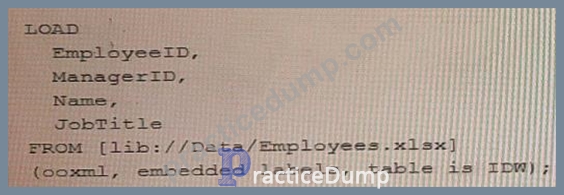
Which two table load prefixes are needed?
- A. * Hierarchy(EmployeelD. ManagerlD Name, Manager Name, Structure V,Depth)
* HierarchyLevelEmployeelD, ManagerlD, Name, Manager, Name, Structure, Depth '/') - B. *HierarchyLevel(EmployeelD, ManagerlD Name Level, '/', Structure)
*HierarchyBelongsTo(EmployeelD, ManagerlD, Name ManagerlD,Manager, Depth) - C. * HierarchyBelongs.To(EmployeeID, ManagerlD, Name ManagerlD, Manager, Depth)
- D. * HierarchyBelongsTo(ManagerlD, Manager, ManagerlD, ManagerlD, Manager Level)
* Hierarchy(EmployeelD, ManagerlD, Name. Manager Name, Structure '/' Depth)
Answer: C
NEW QUESTION # 47
Refer to the exhibits.
A business analyst needs to see the currency conversion provided by a third party process, and only contains a record when the rate changes in a chart. The currency conversion rate data is An existing master calendar exists in the data model that contains a full set of dates.
Which technique should the data architect use to meet this requirement?
- A. OUTER JOIN the calendar with the currency conversion table
ORDER BY the date and use the PEEK function to fill in blank values - B. Use ITERNO and AUTOGENERATE to create a new calendar from max and min dates of the currency conversion table
- C. Leverage a FOR loop between the start date and end date of the master calendar Use the MATCH function to add the currency conversion rates to the master calendar
- D. Utilize INTERVALMATCH to load the currency conversion rate between dates theconversation changed INNER JOIN the resultant table back into the master calendar
Answer: A
NEW QUESTION # 48
Refer to the exhibit.
A data architect loads sales data and creates a table which shows only customers who made purchases in 2018 and 2019. The data architect applies the following set analysis expression on the sales measure.
Count<{<Year={'2 018'}, CustomerID=P({<Year={'2019*}>})>} Customer ID)
Which option shows the resulting table after the expression is applied?
A)
B)
C)
D)
- A. Option A
- B. Option C
- C. Option D
- D. Option B
Answer: C
NEW QUESTION # 49
A data architect wants to combine data on present and historic sales performance.
The historic data is stored in a de-normalized archive, and the present data is maintained in a database.
The output must be contained in a single table.
Which script should the data architect use?
- A.

- B.

- C.

- D.

Answer: C
NEW QUESTION # 50
A data architect completes development of a new app with two data sources Both data sources will also be used by other apps in the future The sources have different data refresh frequencies
* Source 1 Contains frequently updated data and must be refreshed hourly
* Source 2 Contains data that is transferred from a partner and must be refreshed weekly Tasks must be created to load the data sources and make sure that the new app uses the most current data The data will be stored in two QVDs Which tasks should be created to meet these requirements'?
- A. 1 Schedule Task 1 to run hourly and refresh data from Source 1
2 Schedule Task 2 to run weekly and refresh data from Source 2
3. Schedule a task for the app that is dependent on completion of Task 2 that loads the two QVDs - B. 1. Schedule Task 1 to run hourly and refresh data from Source 1
2 Schedule Task 2 that is dependent on Task 1 to refresh data from Source 2
3 Schedule a task for the app that is dependent on completion of Tasks 1 and 2 that loads the two QVDs - C. 1 Schedule Task 1 to run hourly and refresh data from Source 1
2 Schedule Task 2 to run weekly and refresh data from Source 2
3. Schedule a task for the app that is dependent on completion of Tasks 1 or 2 that loads the two QVDs - D. 1. Schedule Task 1 to run hourly and refresh data from Source 1
2 Schedule Task 2 that is dependent on Task 1 to refresh data from Source 2
3. Schedule a task for the app that is dependent on completion of Task 2 that loads the two QVDs
Answer: B
Explanation:
Explanation
This option ensures that the data in the two data sources is always up-to-date by scheduling the data refresh tasks to run at the appropriate frequencies. Task 1 runs hourly to refresh data from Source 1, and Task 2 is dependent on Task 1 so that it runs only after Task 1 is completed. This ensures that the data from Source 2 is loaded only after the most current data from Source 1 is loaded.
NEW QUESTION # 51
A global retailer has a large database in which millions of sales transactions are added per hour.
Each regional sales manager should only see details for customers in their region. After filtering based on criteria such as region, gender,and income level, sales managers should be able to see the most current detailed transactions.
What should a data architect do to meet these requirements?
- A. Use section access and include aservice account in the table
- B. Use On-Demand App Generation (ODAG) and section access
- C. Use section access to restrict sales manager access by region
- D. Create an app for each sales manager with Qlik GeoAnalytics
Answer: C
NEW QUESTION # 52
A data architect executes the following script:
Whatwill be the result of Table A?
A)
B)
C)
D)
- A. Option A
- B. Option C
- C. Option D
- D. Option B
Answer: C
NEW QUESTION # 53
A company has a stream with multiple apps One of the apps is a multi-regional sales app.
A data architect must set up security for users to access the stream, enter the app, and view specific sheets and data.
Whichfeatures should the data architect use to meet these requirements?
- A. Section access and sheet properties
- B. Section access and set analysis
- C. QMC security rules and section access
- D. QMC security rules and custom properties
Answer: C
NEW QUESTION # 54 
Refer io the exhibit.
A data architect needs to modify the script to ONLY load rows from Table_B when Field_1 and Field_2 are the same as in Table_A. (For example, only the row containing A, 1, 456 should be loaded from Table_B.) Which script should the data architect use?
A)
B)
C)
D)
- A. Option A
- B. Option D
- C. Option B
- D. Option C
Answer: C
NEW QUESTION # 55
A data architect needs to upload data from ten different sources, but only if there are any changes after the last reload When data is updated, a new file is placed into a folder mapped to E A439926003 The data connection points to this folder.
The data architect plans a script which will:
1. Verify that the file exists
2. If the file exists, upload it Otherwise, skip to the next piece of code The script will repeat this subroutine for each source. When the script ends, all uploaded files will be removed with a batch procedure.
Which option should the data architectuse to meet these requirements?
- A. FilePath, IF, THEN. Drop
- B. FilePath, FOR EACH, Peek, Drop
- C. FileSize, IF, THEN, END IF
- D. FileExists, FOR EACH, IF
Answer: C
NEW QUESTION # 56
A company generates 1 GB of ticketing data daily. The data is stored in multipletables Business users need to see trends of tickets processed for the past. 2 years Users very rarely access the transaction-level data for a specific date. Only the past 2 years of data must be loaded which is 720 GB of data Which method should a data architect use to meet these requirements?
- A. Load only 2 years ofdata in an aggregated app and create a separate transaction app for occasional use
- B. Load only aggregated data for 2 years and use On-Demand App Generation (ODAG) for transaction data
- C. Load only 2 years of data and use best practices in scripting and visualization to calculate and display aggregated data
- D. Load only aggregated data for 2 years and apply filters on a sheet for transaction data
Answer: B
NEW QUESTION # 57
Multiple department fields in a dataset require a description
A data architect needs to add the department descriptions or a default value when the department does NOT have a description Which strategy should the data architect use to meet these requirements?
- A. ApplyMap with three parameters after the Mapping load
- B. Enter "Missing description" in the blank rows for Description xlsx then Mapping Load
- C. Left Join between tables and Description xlsx in every Department table
- D. ApplyMap with two parameters after the Mapping load
Answer: A
Explanation:
Explanation
This strategy involves using the ApplyMap function with threeparameters after the Mapping load. This will allow the data architect to add the department descriptions or a default value when the department does not have a description.Source: Qlik
NEW QUESTION # 58
......
Qlik QSDA2022 exam is designed for individuals who have experience in data architecture, data modeling, and data analysis. It is recommended to have a minimum of six months of experience in Qlik Sense and data architecture before taking QSDA2022 exam. QSDA2022 exam consists of 50 multiple-choice questions and has a time limit of 90 minutes. The passing score for QSDA2022 exam is 70%.
PracticeDump just published the Qlik QSDA2022 exam dumps!: https://torrentpdf.practicedump.com/QSDA2022-exam-questions.html